Andalusia is the Spain that everyone has in mind: patios full of flowers, bell towers that were once minarets, guitars and the heel-stamping of flamenco, tapas at midnight and a spring sun that already feels like summer. It is also the region where, in just a few days, you can see three of the finest monuments in Europe: the Alcázar of Seville, the Mezquita of Córdoba and the Alhambra of Granada.
This itinerary comes in two versions. In 7 days you visit the three great art cities, with the right amount of time for each. In 10 days you add Ronda, suspended above its gorge, and the Atlantic coast with Cádiz and Jerez de la Frontera, the home of sherry and horses. If you have already seen the three cities, you can choose one of the themed itineraries: al-Andalus, the white villages or flamenco and Lorca.
- Siviglia: the Alcázar, the cathedral and Santa Cruz
- Córdoba: the Mezquita and the Jewish quarter
- Granada: the Alhambra and the Albaicín
- Ronda: the Puente Nuevo above the gorge
- Jerez de la Frontera: the sherry cellars
- Cadice: the city by the sea
Which version to choose
| 7 days | 10 days | |
|---|---|---|
| Cities | Seville, Córdoba, Granada | plus Ronda, Jerez de la Frontera, Cádiz |
| Pace | two or three days per city | a few more transfers, but also days by the sea |
| Transport | train and bus | train and bus, or a car from day 7 |
| Best for | first-time visitors to Andalusia | those who also want to see the coast and the villages |
The two versions share the first six days. With only a week, you close the loop by going back from Granada towards Málaga, which has an airport and is about an hour and a half away by bus; with ten days you continue west and return to Seville.
Days 1 and 2: Seville
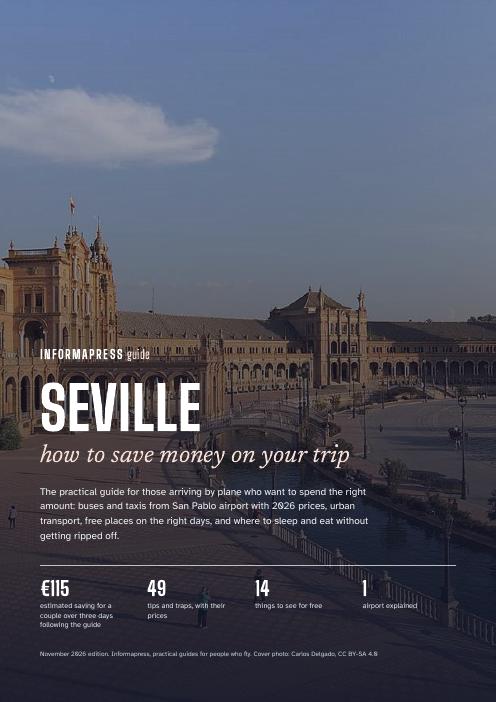
The first day is devoted to the monumental heart of Seville: the cathedral, the largest Gothic church in the world, with the tomb of Christopher Columbus, and the Giralda, the bell tower that was the minaret of the Almohad mosque, climbed by ramps rather than steps. Next to it stands the Real Alcázar, the palace of the kings of Castile, built in the style of the Muslim rulers, with courtyards, stucco work and orange gardens. In the evening, stroll through the Santa Cruz quarter, the old Jewish quarter, among narrow lanes and little squares with orange trees.
On the second day, head to the Plaza de España and María Luisa Park, then cross the Guadalquivir to the Triana district, home of potters and sailors, with its market and azulejo workshops. Watch the sunset from the top of the Metropol Parasol, the great wooden "Setas". Evening is the time for flamenco: Seville has tablaos and small venues in almost every neighbourhood. See also the map of Seville.
Where to sleep: in Seville, two nights.
Day 3: Córdoba
The high-speed train reaches Córdoba in about three quarters of an hour. The morning belongs to the Mezquita, the great eighth-century mosque with its forest of red and white arches, inside which the Christians built a cathedral. Continue to the Jewish quarter, with the synagogue and the Calle de las Flores, and cross the Roman bridge to the Calahorra tower. Those travelling in May will find the patios festival, when the houses open their flower-filled courtyards.
Where to sleep: in Córdoba, one night (or return to Seville and leave for Granada the next day).
Days 4, 5 and 6: Granada
From Córdoba to Granada the train takes about an hour and three quarters. In the afternoon, climb up to the Albaicín, the old Arab quarter, as far as the Mirador de San Nicolás, from which the Alhambra can be seen lit up by the sunset with the Sierra Nevada behind it.
Day 5 is the day of the Alhambra: the Nasrid Palaces, to be visited at the time shown on the ticket, the Alcazaba and the gardens of the Generalife. Allow at least four hours. On day 6 you see the cathedral and the Royal Chapel, where the Catholic Monarchs are buried, then the Sacromonte, the district of houses dug into the hillside, where cave flamenco was born. In Granada, in many bars, a free tapa arrives with every drink.
Where to sleep: in Granada, three nights.
End of the 7-day version: on day 7 you travel from Granada to Málaga airport by bus, with a walk in the centre and at the Alcazaba before the flight.
Day 7: Ronda (10-day version only)
From Granada to Ronda it takes about two and a half hours by car, or a few hours more by public transport. Ronda stands above a gorge more than a hundred metres deep, crossed by the Puente Nuevo, the eighteenth-century bridge that is the symbol of the city. Visit the bullring, one of the oldest in Spain, the House of the Moorish King with its stairway down to the river, and the viewpoint in the Cuenca gardens. Those with a car can stop along the way in one of the white villages, such as Setenil de las Bodegas, with houses built under the rock.
Where to sleep: in Ronda, one night.
Day 8: Jerez de la Frontera
From Ronda the road descends towards the Atlantic. Jerez is the city of sherry, the fortified wine that matures in the bodegas, the great cellars with high roofs: many can be visited with a tasting. Jerez is also the city of Andalusian horses, seen in the shows of the Royal Andalusian School of Equestrian Art, and one of the most authentic places for flamenco.
Where to sleep: in Jerez or already in Cádiz, one night.
Day 9: Cádiz
Cádiz is one of the oldest cities in Europe, founded by the Phoenicians and almost entirely surrounded by the sea. Stroll along the seafront, visit the cathedral with its golden dome, climb the Torre Tavira to see the city from above and swim at La Caleta, the beach between two castles. In the evening, eat fried fish in the La Viña district. See the cuisine of Cádiz.
Where to sleep: in Cádiz, one night.
Day 10: back to Seville
From Cádiz to Seville the fastest trains take about an hour and a half, with a stop at Jerez. Those with an afternoon flight can spend the morning on a last stroll in Cádiz or at the central market.
Train or car?
Between Seville, Córdoba and Granada the train is the best choice: the stations are close to the centres, the historic centres have restricted traffic zones and parking is expensive. For Ronda, the white villages and the coast a car saves a lot of time; it is best to hire one on day 7 in Granada and return it in Seville. See getting around Spain.
When to go
The best months are March, April, May, October and November, with warm days and cool evenings. In April come Holy Week and the Feria de Abril of Seville, both wonderful but with high prices and full hotels. From June to September inland, in Seville and Córdoba, temperatures often exceed 40 degrees: visits are best made early in the morning and in the evening. In winter the days are mild and the monuments less crowded, but nights in Granada are cold.
Practical tips
- Buy the Alhambra ticket only on the official website, well in advance, and bring the identity document named at the time of purchase.
- In the Mezquita and the cathedrals, cover shoulders and knees.
- In Andalusia lunch is after 2 pm and dinner after 9 pm: many kitchens are closed at 7 pm.
- For high-speed trains, booking early costs less.
See also Andalusia, the cities of Andalusia and the other itineraries in Spain.
Frequently asked questions
Are 7 days enough for Andalusia? They are enough for Seville, Córdoba and Granada without rushing; to add Ronda and the coast you need at least three more days.
Is it better to start from Seville or from Málaga? It depends on the flights: the route works in both directions. Starting from Málaga, you visit Granada first and finish in Seville.
Do I need a car? Not for the three great cities; for Ronda, the white villages and the coast it is very convenient.
How far ahead should the Alhambra be booked? In spring and summer the tickets sell out even weeks ahead: it is best to buy them as soon as the travel dates are known.